



- 27th Oct '26
- Ainycs
- 19 minutes read
9 Best Email Marketing Strategies for B2B Success in 2026
In the fast-paced world of B2B marketing, email remains a powerful tool for fostering relationships and driving sales. This article from Ainycs test delves into the top strategies for achieving B2B success in 2026, offering a comprehensive guide to navigating the complexities of business-to-business communication. Readers will explore the nuances of B2B email marketing, learn about essential platforms like Mailchimp, Brevo, and HubSpot, and discover best practices for nurturing long-term client relationships. The article also highlights the importance of understanding the buyer's journey and effective segmentation to boost engagement. By examining successful email campaigns, businesses can gain insights into crafting compelling content that resonates with decision-makers. With practical advice and actionable tips, this article equips marketers with the knowledge to enhance their email strategies and achieve measurable results in the competitive B2B landscape.
What is B2B Email Marketing?
Understanding B2B Email Marketing
B2B email marketing involves businesses sending emails to other companies rather than individual consumers. This approach is distinct from B2C marketing, where the focus is on engaging individual customers. In B2B, emails are tailored to address the needs and interests of various stakeholders within a company. For example, when reaching out to a business, the content might be directed towards decision-makers like purchasing managers or department heads, focusing on products or services that meet their organizational needs.
The Lengthy B2B Buying Cycle
One of the defining characteristics of B2B email marketing is the extended buying cycle. Unlike B2C transactions, which can often be impulsive and quick, B2B purchases typically take weeks or even months. This is because B2B transactions often involve larger investments and require the consensus of multiple stakeholders. Each party involved may have different priorities, such as budget considerations, technical requirements, or operational benefits, which need to be addressed over time.
Nurturing Complex Relationships
Effective B2B email marketing is not just about making a sale; it is about nurturing complex relationships over time. By strategically sending informative content, such as whitepapers, case studies, and industry insights, businesses can demonstrate value at each stage of the buying journey. This approach helps keep potential clients engaged and informed, ultimately guiding them towards a purchasing decision. For more insights on this approach, visit this detailed guide.
Constant Contact
Key Features of Constant Contact
Constant Contact is a user-friendly platform designed to simplify B2B email marketing for businesses of all sizes. Its intuitive interface makes it an ideal choice for those new to email marketing, offering a straightforward setup process and excellent customer support. One of its standout features is the event registration tools, which are particularly beneficial for businesses that host events or need to gather audience feedback through surveys and polls.
The platform also supports webhooks, allowing seamless integration with other applications to enhance workflow efficiency. Additionally, Constant Contact includes a range of templates tailored to various industries, ensuring that businesses can maintain a professional appearance in their communications.
Pros and Cons to Consider
When evaluating Constant Contact as part of the best email marketing strategies for b2b, it's important to weigh its advantages against its limitations. On the positive side, the platform offers responsive customer support, social media management tools, and automated email campaigns that can send personalized messages based on user behavior. However, there are some drawbacks to consider, such as limited advanced automation features and audience segmentation tools.
Pricing and Plans
Constant Contact offers plans starting at $12 per month for up to 500 contacts and 5,000 emails. While it doesn't provide a free plan, a 14-day free trial is available for businesses to test its features. Discounts of up to 15% are available for those who commit to a 12-month prepayment, and nonprofits can receive up to 30% off.
- Evaluate the ease of use and customer support offered by Constant Contact.
- Consider the platform's integration capabilities and available templates.
- Assess the pricing plans and available discounts for long-term commitments.
1. Mailchimp
Key Features of Mailchimp for B2B Marketing
Mailchimp is a powerful tool that offers several features tailored to enhance B2B email marketing efforts. Its user-friendly platform allows businesses to create targeted campaigns with ease. Some of the core features include:
- Advanced Segmentation: Mailchimp enables users to segment their email lists based on various criteria, ensuring that the right message reaches the right audience.
- Automation Tools: With automation, businesses can set up email sequences that nurture leads at different stages of the buyer's journey.
- Analytics and Reporting: Comprehensive analytics provide insights into campaign performance, helping businesses measure email effectiveness as a revenue channel.
These features make Mailchimp a robust choice for B2B companies aiming to optimize their email marketing strategies and drive better engagement with their target audiences.

2. Brevo
Understanding Brevo's Role in B2B Email Marketing
Brevo is an essential tool in the realm of B2B email marketing, which involves businesses sending emails to other companies rather than individual consumers. This distinction is crucial as it shapes the strategies and tools used in campaigns. Brevo offers features that are particularly suited for B2B needs, focusing on building and nurturing long-term relationships. Its capabilities include advanced segmentation and personalization, allowing businesses to tailor their messages to specific companies and decision-makers, which is a cornerstone of successful B2B communication.Core Points to Know About Brevo
One of the core aspects of Brevo is its ability to measure email campaigns as a revenue channel. This is vital for businesses aiming to track the effectiveness of their marketing efforts in tangible terms. By analyzing metrics such as open rates, click-through rates, and conversion rates, companies can refine their strategies to better align with their sales goals. Additionally, Brevo emphasizes the importance of crafting compelling subject lines, which are often the first impression a recipient has of an email. A well-crafted subject line can significantly increase the likelihood of an email being opened, thereby enhancing engagement. For those looking to optimize their email marketing strategies, understanding the buyer's journey is crucial. Brevo provides a structured approach to mapping this journey, helping businesses align their email content with the different stages of the buying process. This ensures that each email sent is relevant and timely, increasing the chances of conversion. To further enhance your B2B email marketing efforts, consider exploring our 3 Best Email Sequences For Lead Generation A Comprehensive Step By Step Guide. This resource provides valuable insights into crafting effective email sequences that drive results. By integrating Brevo into your strategy, you can leverage one of the best email marketing strategies for B2B to foster meaningful business relationships and drive growth.3. GetResponse
Understanding GetResponse for B2B Email Marketing
GetResponse is a powerful tool that can enhance B2B email marketing efforts by focusing on the unique needs of businesses communicating with other companies. Unlike B2C, where the target is individual consumers, B2B email marketing involves crafting messages that resonate with business clients and decision-makers. GetResponse offers features such as advanced segmentation, which allows us to tailor emails to specific industries or roles within a company, ensuring that each message is relevant and impactful. In the B2B landscape, nurturing relationships over time is crucial. GetResponse excels in this area by providing automation capabilities that allow us to schedule and send a series of emails designed to guide potential clients through the buyer's journey. This structured approach helps maintain engagement and fosters long-term business relationships.Core Points to Know About GetResponse
One of the standout features of GetResponse is its emphasis on measuring email as a revenue channel. With robust analytics, we can track key metrics such as open rates, click-through rates, and conversions, providing valuable insights into the effectiveness of our campaigns. This data-driven approach enables us to refine our strategies and maximize return on investment. Moreover, GetResponse places significant importance on email subject lines, which are critical in capturing the attention of busy professionals. The platform offers tools to test and optimize subject lines, ensuring that our emails not only reach the inbox but also entice recipients to open them. For businesses looking to enhance their B2B email marketing, leveraging these features can lead to more effective campaigns and improved sales outcomes. For more insights on optimizing lead generation using email tools, explore our 5 Best Strategies To Improve Lead Generation Using Email Tools.4. HubSpot
Understanding B2B Email Marketing
B2B email marketing is a specialized approach where businesses communicate directly with other companies through email. The primary goal is to build long-term relationships, focusing on providing value and nurturing leads over time. HubSpot is a powerful tool in this domain, offering features that cater specifically to the needs of B2B marketers.
Key Features of HubSpot for B2B
One of the standout features of HubSpot is its ability to measure email marketing as a revenue channel. This capability allows businesses to track the performance of their campaigns and understand the impact on their bottom line. By analyzing metrics such as open rates, click-through rates, and conversion rates, companies can refine their strategies and optimize their efforts for better results.
Another critical aspect of HubSpot's offering is its focus on crafting compelling subject lines, which can significantly enhance the effectiveness of email campaigns. For more insights into effective B2B email marketing strategies, you can explore platforms focused on lead generation.
5. ActiveCampaign
ActiveCampaign's Role in B2B Email Marketing
ActiveCampaign is a powerful tool for businesses looking to enhance their B2B email marketing efforts. This approach requires a different strategy, emphasizing the importance of building and nurturing long-term relationships. ActiveCampaign excels in this domain by offering features that help businesses automate and personalize their email campaigns, ensuring they resonate with the corporate audience.
Key Features of ActiveCampaign for B2B Success
One of the standout features of ActiveCampaign is its ability to map the buyer's journey effectively. This structured approach allows businesses to tailor their communication according to the different stages of the buying process, enhancing engagement and conversion rates. Additionally, ActiveCampaign emphasizes the significance of subject lines in email marketing, which can significantly increase open rates.
By providing detailed analytics and insights, businesses can track the effectiveness of their campaigns, understand what works, and make data-driven decisions to optimize future efforts.

6. AWeber
Understanding AWeber's Role in B2B Email Marketing
AWeber is a well-established email marketing platform that offers a range of features tailored to the needs of B2B companies. AWeber supports this by providing tools that help businesses nurture relationships over time, which is crucial for B2B success. The platform emphasizes the importance of crafting compelling subject lines and measuring email performance as a revenue channel.
Key Features of AWeber for B2B Success
AWeber provides a structured approach to mapping the buyer's journey, allowing businesses to create targeted email campaigns that align with each stage of the sales funnel. This feature is particularly beneficial for B2B companies aiming to guide potential clients from awareness to decision-making. AWeber's platform also includes robust analytics tools that enable businesses to track engagement metrics, such as open rates and click-through rates.
| Feature | Description |
|---|---|
| Buyer Journey Mapping | Helps align email campaigns with stages of the sales funnel. |
| Analytics Tools | Tracks open rates and click-through rates for performance insights. |
| Customizable Templates | Enables creation of tailored email content for specific audiences. |
Overall, AWeber's comprehensive suite of tools and features makes it a valuable asset for B2B companies looking to enhance their email marketing efforts.
Best Practices for B2B Email Marketing
Nurturing Complex Relationships Over Time
In B2B email marketing, the buying cycle is notably longer, often extending over weeks or even months. This duration provides a unique opportunity to nurture complex relationships with potential clients. Unlike B2C interactions, B2B engagements require a deeper understanding of the client's needs and a tailored approach to communication. By leveraging email marketing, businesses can maintain consistent contact, offering valuable insights and solutions that align with the client's evolving requirements.
Effective B2B email marketing strategies focus on building trust and providing ongoing value. This can be achieved through personalized content that addresses specific pain points and industry trends relevant to the recipient. Over time, this approach helps to solidify relationships, positioning your business as a trusted partner rather than just a service provider.
Measuring Success with the B2B Email Marketing Revenue Framework
To ensure the effectiveness of B2B email marketing efforts, it is crucial to adopt a structured framework for measuring success. The B2B Email Marketing Revenue Measurement Framework offers a comprehensive approach by focusing on key metrics such as pipeline sourced, pipeline influenced, velocity impact, and average contract value. These metrics provide a clear picture of how email campaigns contribute to revenue generation.
For instance, monitoring the pipeline sourced helps identify the volume of leads generated directly from email campaigns. Meanwhile, pipeline influenced measures the extent to which email campaigns assist in advancing prospects through the sales funnel. By analyzing these metrics, businesses can refine their strategies to enhance performance and drive sales growth.
Comparison of Tools for Effective B2B Email Marketing
When selecting tools to enhance B2B email marketing, it's important to consider options that align with your specific needs. Platforms like HubSpot offer comprehensive solutions for automating email campaigns and tracking engagement metrics. HubSpot's tools are known for their integration capabilities and extensive analytics, though pricing can be higher compared to other options.
On the other hand, platforms focused on data enrichment tools can help teams enhance lead quality by providing detailed insights into prospects. These tools often offer competitive pricing and are ideal for businesses looking to optimize their outreach efforts without extensive overhead costs.
| Tool | Features | Pricing |
|---|---|---|
| HubSpot | Automation, Analytics, Integration | Pricing unclear |
| Data Enrichment Platforms | Lead Quality Enhancement, Insights | Competitive |
- Segment ruthlessly for relevance – Tailor messages based on detailed criteria to enhance engagement.
- Write subject lines that promise value – Focus on benefits rather than clickbait to improve open rates.
- Personalize beyond the first name – Use detailed company information to strengthen connections.
7. Mapping Your Buyer's Journey
Understanding the Lengthy B2B Buying Cycle
In the world of B2B, buying cycles are notably longer, often taking weeks or even months to complete. This extended timeline is due to the complexity of decision-making processes, which typically involve multiple stakeholders. Businesses need to be patient and persistent in their email marketing strategies, focusing on nurturing relationships over time.
Core Stages of the Buyer's Journey
Mapping the buyer's journey involves identifying and understanding the key stages that prospects pass through. Typically, this journey can be divided into three core stages: the early stage, mid-stage, and late stage. Each stage demands a different approach and type of content to effectively engage and convert prospects.
In the early stage, prospects are problem-aware but not yet considering solutions. Here, the goal is to educate and provide valuable insights through industry reports and challenge-focused content. As prospects move to the mid-stage, they become solution-aware, actively researching options. At this point, emails should focus on showcasing unique approaches and building preference through frameworks and comparison guides.
Finally, in the late stage, prospects are evaluating vendors, including you and your competitors. The objective here is to reinforce value and address any remaining objections. Providing customer testimonials, ROI calculators, and implementation timelines can be effective strategies to close the deal.
| Stage | Focus | Email Content |
|---|---|---|
| Early Stage | Problem Awareness | Industry reports, challenge-focused content |
| Mid-Stage | Solution Awareness | Framework content, comparison guides |
| Late Stage | Vendor Evaluation | Customer proof, ROI calculators |
8. Segmentation for Higher Engagement
Nurturing Relationships Through Effective Email Marketing
One of the best email marketing strategies for B2B is to focus on nurturing relationships over time. Effective email marketing is not just about sending promotional content; it's about building trust and providing value at every touchpoint. By segmenting your audience based on their position in the buying cycle, you can deliver personalized content that addresses specific pain points and interests.
To achieve this, consider implementing the following strategies:
- Develop targeted email sequences that align with each stage of the buying journey.
- Utilize data-driven insights to personalize content and improve relevance.
- Regularly assess engagement metrics to refine and optimize your approach.
Core Points to Know
When implementing segmentation for higher engagement, it's crucial to remember a few core points:
- Segmentation allows for more personalized and relevant communication.
- Effective segmentation requires a deep understanding of your audience's needs and behaviors.
- Regular updates and adjustments to your segmentation strategy can significantly improve outcomes.
For a deeper dive into B2B email marketing strategies, platforms focused on data enrichment tools can help teams optimize their efforts and drive better engagement.
9. Examples of Successful B2B Email Campaigns
Core Points to Know
B2B email marketing is a strategic approach where businesses communicate with other companies via email, focusing on building long-term relationships and nurturing leads over time. Successful B2B email campaigns often emphasize the importance of subject lines, as they are crucial in capturing the recipient's attention. Crafting compelling subject lines can significantly improve open rates, which is the first step in engaging potential business clients.
Practical Decisions and Tradeoffs
When designing a B2B email campaign, businesses must consider the balance between personalization and automation. While automated campaigns can save time and resources, they should still feel personalized and relevant to the recipient. This requires a structured approach to mapping the buyer's journey, ensuring that each email aligns with the recipient's stage in the decision-making process.
Another important consideration is the choice of email marketing software. Platforms that offer advanced features such as AI-powered data enrichment tools can enhance lead generation efforts. For those interested in exploring the best options available, a comprehensive list of top B2B email marketing software can be found here.
Conclusion
In 2026, mastering the art of B2B email marketing is essential for businesses aiming to thrive in a competitive landscape. As explored in this article from Ainycs test, understanding the nuances of B2B communication is crucial, where emails are crafted to resonate with decision-makers and stakeholders within companies. The platforms discussed, such as Mailchimp, Brevo, and HubSpot, offer advanced segmentation and automation tools that are indispensable for tailoring messages to specific audiences. Additionally, best practices like mapping the buyer's journey and effective segmentation are fundamental to nurturing long-term relationships and increasing engagement. By examining successful B2B email campaigns, businesses can gain insights into creating compelling content that captures attention and drives action. To truly leverage these strategies, marketers should focus on implementing a comprehensive approach that includes understanding the extended B2B buying cycle and crafting personalized content. As a practical next step, consider evaluating your current email marketing platforms and strategies to ensure they align with the sophisticated demands of B2B marketing, thereby positioning your business for success in the years to come.
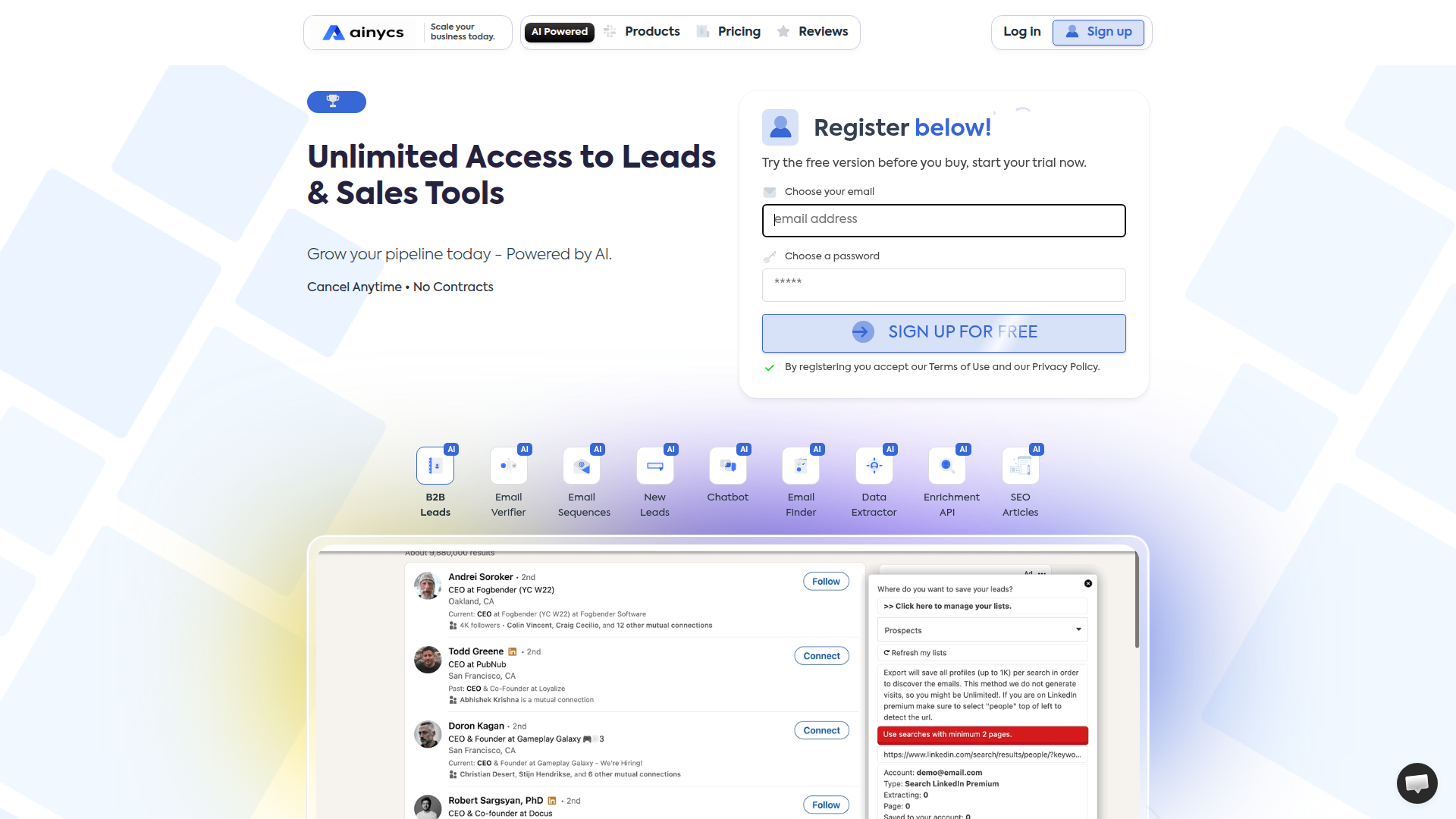
For businesses aiming to excel in their email marketing strategies for B2B, Ainycs offers an AI-powered software suite that simplifies lead generation and enhances sales processes. With tools like a B2B leads extractor from LinkedIn and an email verifier API, Ainycs ensures you gather valid and targeted email lists efficiently. By providing customizable email sequences and daily updates on new domains, Ainycs empowers your team to execute impactful outreach campaigns and track engagement metrics, driving significant sales growth. Discover more with Ainycs today!
FAQ
- What distinguishes B2B email marketing from B2C?
B2B email marketing focuses on engaging businesses rather than individual consumers. It involves crafting emails that address the needs of various stakeholders within a company, such as decision-makers like purchasing managers. This approach is tailored to build long-term relationships and address complex organizational needs. - How does Constant Contact support B2B email marketing?
Constant Contact offers a user-friendly platform with features like event registration tools and audience feedback surveys, which are beneficial for businesses hosting events. Its integration capabilities and industry-specific templates help maintain a professional appearance, making it an ideal choice for those new to email marketing. - What are the key features of Mailchimp for B2B marketing?
Mailchimp provides advanced segmentation, allowing businesses to target specific audiences effectively. Its automation tools facilitate nurturing leads through email sequences, while comprehensive analytics help measure campaign performance, making it a robust choice for optimizing B2B email strategies. - How does Brevo enhance B2B email marketing efforts?
Brevo focuses on building long-term relationships through advanced segmentation and personalization, tailoring messages to specific companies and decision-makers. It emphasizes the importance of compelling subject lines and provides tools to map the buyer's journey, ensuring relevant and timely communication. - What makes GetResponse suitable for B2B email marketing?
GetResponse excels in advanced segmentation, allowing businesses to tailor emails to specific industries or roles. Its automation capabilities support nurturing relationships over time, while robust analytics provide insights into campaign effectiveness, enabling data-driven strategy refinements. - How does HubSpot cater to B2B email marketers?
HubSpot offers features that measure email marketing as a revenue channel, providing insights into campaign performance. It emphasizes crafting compelling subject lines and supports businesses in refining their strategies for better results, making it a powerful tool for building long-term B2B relationships. - What role does ActiveCampaign play in B2B email marketing?
ActiveCampaign aids in mapping the buyer's journey, allowing businesses to tailor communication according to different buying stages. It emphasizes the importance of subject lines in increasing open rates and provides detailed analytics to optimize future campaigns, enhancing engagement and conversion rates. - How does AWeber support B2B companies?
AWeber offers tools for nurturing long-term relationships, crucial for B2B success. It focuses on crafting compelling subject lines and measuring email performance, providing a structured approach to maintaining engagement and driving sales outcomes for B2B companies. - What are the best practices for B2B email marketing?
Best practices include understanding the lengthy B2B buying cycle and nurturing complex relationships over time. By leveraging email marketing to provide valuable insights and solutions, businesses can maintain consistent contact with potential clients, guiding them toward purchasing decisions. - Can you give examples of successful B2B email campaigns?
Successful B2B email campaigns often focus on crafting compelling subject lines to capture attention and improve open rates. By examining these campaigns, businesses can gain insights into creating engaging content that resonates with decision-makers, enhancing their overall email marketing strategy.