



- 02nd Nov '26
- Ainycs
- 24 minutes read
How to Automate Lead Generation with AI Tools: A Step-by-Step Guide
In today's competitive business landscape, harnessing the power of artificial intelligence to streamline lead generation processes is more crucial than ever. This comprehensive guide will walk you through the essential steps to effectively automate lead generation using advanced AI tools. From setting clear objectives and selecting the most suitable AI solutions to integrating them with your CRM and creating targeted campaigns, each section provides actionable insights. You'll learn how to enhance your lead database with AI-driven data enrichment, automate outreach with personalized email campaigns, and engage prospects in real-time using chatbots. Additionally, the guide covers monitoring and analyzing results to optimize your strategy and scale your efforts. By addressing common challenges and offering troubleshooting tips, this article equips you with the knowledge to leverage AI for maximizing sales growth and efficiency.
Identify Your Lead Generation Goals Before Automation
Understanding Your Lead Generation Objectives
Before diving into automation, it's crucial to clearly define your lead generation objectives. These goals will guide your strategy and help select the right AI tools. Start by determining what type of leads you need. Are you looking for high-volume, low-quality leads, or fewer but higher-quality prospects? Knowing this will influence the tools and methods you choose.
Consider also the specific metrics you aim to improve. Whether it's increasing conversion rates or expanding your lead database, having quantifiable targets will provide a benchmark for success. Align these goals with your overall business strategy to ensure consistency and relevance.
Avoiding Common Mistakes in Goal Setting
One common pitfall is setting overly broad or unrealistic goals. Vague objectives like "increase sales" lack the specificity needed for effective automation. Instead, aim for clear, measurable outcomes such as "boost lead conversion by 20% within six months." This precision helps in evaluating the effectiveness of your approach.
Another mistake is neglecting to revisit and adjust goals as your business evolves. Regularly reviewing your objectives ensures they remain aligned with your current market conditions and business needs. This adaptability is key to maintaining a competitive edge.
As you refine your goals, consider integrating strategies from resources like the 5 Best Strategies To Improve Lead Generation Using Email Tools. Such insights can complement your AI-driven efforts, enhancing overall effectiveness.
Having established your lead generation goals, the next step is to explore the various AI tools available that can effectively support these objectives.
Choose the Right AI Tools for Lead Generation
Understanding Key Features and Benefits
Before you dive into selecting AI tools for lead generation, it's crucial to understand the key features and benefits that these tools offer. AI tools can automate repetitive tasks, analyze large datasets, and provide insights into customer behavior. These capabilities can significantly enhance your lead generation efforts by increasing efficiency and accuracy. For instance, AI-driven tools often include features like predictive analytics, which help anticipate customer needs and personalize marketing efforts.
Additionally, many AI tools integrate seamlessly with existing CRM systems, enabling a smoother workflow and better data management. Understanding these features will help you make informed decisions about which tools align with your business needs and goals.
Avoiding Common Mistakes in Tool Selection
When deciding how to automate lead generation with AI tools, businesses often make the mistake of choosing tools based solely on popularity or price. This approach can lead to mismatched capabilities and unmet expectations. To avoid this, consider the specific needs of your business and how each tool can address those needs. Evaluate tools based on criteria such as ease of use, integration capabilities, and support services.
Another common pitfall is neglecting to test tools before full implementation. Always conduct a trial run to ensure the tool performs as expected in your business environment. This step can save time and resources by preventing future issues.
Evaluating the Effectiveness of Your AI Tools
Once you've implemented AI tools, it's important to regularly evaluate their effectiveness. Start by setting clear metrics to measure success, such as the number of qualified leads generated or the time saved on manual tasks. Monitor these metrics over time to determine if the tools are meeting your expectations.
Consider the following steps to assess tool performance:
- Review lead conversion rates before and after implementation.
- Analyze the quality of leads generated by the AI tools.
- Gather feedback from team members using the tools daily.
By following these steps, you can ensure that your choice of AI tools continues to support your lead generation objectives effectively.
Set Up Your AI Tools for Optimal Performance
Understanding Key Setup Requirements
Before diving into the setup process, it's crucial to understand the essential requirements for optimizing AI tools in lead generation. The first step involves ensuring that your data is clean and well-organized. AI tools rely heavily on data quality, so any inaccuracies or inconsistencies can lead to suboptimal performance. Typically, this means verifying that your customer databases are up-to-date and free from duplicates.
Another important consideration is the compatibility of the AI tools with your existing systems. Many businesses overlook this, leading to integration challenges that can hinder performance. Ensure that the AI tool you choose can seamlessly integrate with your current CRM or marketing platforms. This will allow for a smoother transition and more effective use of AI capabilities.
- Data Quality: Ensure your data is clean and well-organized.
- System Compatibility: Check if the AI tools integrate with your existing platforms.
- Customization: Tailor AI settings to align with your goals.
Avoiding Common Mistakes in AI Tool Setup
One common mistake businesses make is skipping the customization phase. AI tools often come with default settings that may not align with your specific lead generation goals. Take the time to customize these settings to match your target audience and sales objectives. This involves configuring parameters such as lead scoring criteria and communication preferences.
Another frequent error is neglecting to monitor and evaluate the tool's performance regularly. Establish a routine to assess how well the AI tool is meeting your lead generation targets. Key performance indicators (KPIs) such as conversion rates and lead quality should be tracked to determine if adjustments are needed. This ongoing evaluation helps ensure that the AI tools are contributing effectively to your overall strategy on how to automate lead generation with AI tools.

Integrate AI Tools with Your Existing CRM System
Understanding Integration Requirements
Before integrating AI tools with your CRM system, it's crucial to understand the specific requirements and compatibility issues. Not all AI tools are designed to work seamlessly with every CRM platform. Assess the technical specifications of both your CRM and the AI tools to ensure they can communicate effectively. Consider factors like data formats, API availability, and the ability to handle real-time data processing.
Additionally, evaluate the scalability of the integration. As your business grows, your CRM and AI tools should be able to scale without significant reconfiguration. This foresight can save time and resources in the long run.
Avoiding Common Integration Mistakes
One common mistake is underestimating the importance of data quality. Ensure your CRM data is clean and well-organized before integration. Poor data quality can lead to inaccurate AI insights, which can hinder your lead generation efforts. Regularly update and maintain your data to keep your system running smoothly.
Another pitfall is neglecting user training. Employees need to understand how to use the integrated system effectively. Provide comprehensive training sessions to familiarize your team with new workflows and functionalities. This will help maximize the benefits of your AI-enhanced CRM system.
Evaluating Integration Success
Once the integration is complete, it's important to evaluate its effectiveness. Set clear KPIs to measure success, such as increased lead conversion rates or reduced response times. Regularly review these metrics to ensure the integration is delivering the desired results.
Gather feedback from users to identify any operational issues or areas for improvement. This feedback can provide valuable insights into how the integration is performing and where adjustments might be needed. Continuous monitoring and optimization are key to maintaining a successful AI-CRM integration.
Create Targeted Lead Generation Campaigns Using AI
Key Considerations Before Launching AI-Driven Campaigns
Before diving into AI-driven lead generation campaigns, it's crucial to understand the fundamental aspects that can influence their success. First, identify your target audience with precision. AI tools excel in analyzing data patterns, but they need clear parameters to function effectively. Define demographic details such as age, location, and interests to ensure the AI can tailor messages appropriately.
Another important factor is setting clear objectives. Whether your goal is to increase brand awareness, generate qualified leads, or boost sales, having a specific aim will guide the AI in optimizing strategies. Additionally, ensure your data is clean and well-organized. AI systems rely on quality data to make accurate predictions and decisions, so invest time in data cleansing and management.
Avoiding Common Pitfalls in AI Campaigns
One common mistake in AI campaigns is over-relying on the technology without human oversight. While AI can automate processes and provide insights, human intuition and creativity are indispensable. Regularly review AI-generated content and strategies to ensure they align with your brand voice and objectives.
Another pitfall is neglecting to evaluate the effectiveness of your campaigns. Establish metrics such as conversion rates, click-through rates, and lead quality to measure performance. Regular analysis will help you refine strategies and make data-driven decisions. For more insights into AI tools, explore the Top 7 Ainycs Vs Other Lead Generation Tools 2026.
Utilize AI for Data Enrichment and Lead Scoring
Understanding the Role of AI in Data Enrichment
Before diving into AI tools for data enrichment, it's crucial to understand their purpose and functionality. AI-driven data enrichment involves enhancing existing data by filling in gaps with additional information, such as social media profiles, job titles, and contact details. This process ensures that your lead database is comprehensive and up-to-date, enabling more personalized marketing efforts.
AI tools achieve this by analyzing vast datasets and identifying patterns that might not be immediately apparent. By leveraging machine learning algorithms, these tools can predict missing data points and validate existing information, ensuring accuracy and relevance. This enriched data forms the foundation for effective lead scoring, allowing businesses to prioritize leads more efficiently.
Common Pitfalls in Lead Scoring and How to Avoid Them
When implementing AI-driven lead scoring, businesses often encounter common pitfalls that can hinder effectiveness. One frequent mistake is relying solely on historical data without considering real-time updates. This approach can lead to outdated scoring, reducing the accuracy of lead prioritization. To avoid this, ensure your AI tools integrate with real-time data sources, keeping your lead scores current and actionable.
Another common error is failing to customize scoring models to align with specific business goals. Generic models might not accurately reflect the unique characteristics of your target audience or sales process. Tailor your scoring criteria to match your business objectives, focusing on factors that truly indicate a lead's potential value. Regularly review and adjust these criteria based on performance metrics to maintain alignment with evolving business needs.
Evaluating the Effectiveness of Your AI Approach
Once AI tools are in place for data enrichment and lead scoring, it's vital to evaluate their effectiveness regularly. Key performance indicators (KPIs) such as conversion rates, lead engagement levels, and sales cycle duration can provide insights into the success of your AI strategy. Monitoring these metrics helps identify areas for improvement and ensures that your approach remains aligned with business objectives.
Additionally, consider conducting A/B tests to compare the performance of AI-enhanced lead scoring against traditional methods. This comparison can highlight the tangible benefits of AI, such as increased efficiency and higher lead conversion rates. By continuously refining your AI strategy based on these evaluations, you can maximize the impact of data enrichment and lead scoring on your overall lead generation efforts.
For more insights into leveraging AI in sales, explore platforms focused on data enrichment tools that can help teams streamline their processes.
Automate Outreach with AI-Powered Email Campaigns
Understanding AI Email Campaigns
Before diving into AI-powered email campaigns, it's crucial to understand their core functionality. These campaigns leverage machine learning algorithms to personalize and automate the process of reaching out to potential leads. By analyzing data such as past interactions and customer behavior, AI tools can craft tailored messages that resonate with each recipient, increasing the likelihood of engagement.
AI email platforms typically offer features like segmentation, predictive analytics, and automated scheduling. These tools help businesses send the right message at the optimal time, maximizing the chances of conversion. However, it's important to select a platform that aligns with your specific business needs, as features and pricing can vary significantly.
Avoiding Common Pitfalls
When implementing AI-powered email campaigns, businesses often make a few common mistakes. One frequent error is neglecting to segment the audience properly. Without effective segmentation, even the most sophisticated AI tool can't deliver personalized content that engages recipients.
Another mistake is over-reliance on automation. While AI can streamline many processes, it's essential to maintain a human touch. Ensure that your messages reflect your brand's voice and values, as overly robotic communications can alienate potential leads.
Practical Steps for Implementation
To successfully implement AI email campaigns, start by defining clear objectives. Determine what you aim to achieve, whether it's boosting open rates, increasing conversions, or improving customer retention. Next, choose an AI platform that offers the features necessary to meet these goals. Evaluate options based on criteria such as ease of use, integration capabilities, and pricing.
Once you've selected a platform, begin by segmenting your audience into distinct groups based on demographics, behavior, or purchase history. Craft personalized messages for each segment, leveraging AI to optimize send times and content. Regularly evaluate the performance of your campaigns through metrics like open rates and click-through rates to ensure they are meeting your objectives.
For further insights on integrating AI into your lead generation strategy, consider exploring how chatbots can enhance real-time engagement.

Leverage Chatbots for Real-Time Lead Engagement
Key Features of an Effective Lead Generation Chatbot
An effective lead generation chatbot should possess several key features to maximize its potential. Firstly, it must have the ability to engage visitors in real time, providing instant responses to queries. This real-time interaction is crucial for qualifying prospects using frameworks such as BANT (Budget, Authority, Need, Timing) or CHAMP (Challenges, Authority, Money, Prioritization). Additionally, the chatbot should be capable of collecting user data seamlessly, enabling personalized communication that enhances the overall user experience.
Integration with existing CRM systems is another essential feature. This allows for immediate lead routing and follow-up, ensuring no potential customer slips through the cracks. Furthermore, chatbots should support 24/7 lead capture and nurturing, which is vital for businesses operating across different time zones. These features collectively streamline the lead generation process, making it more efficient and effective.
Metrics for Measuring Chatbot Performance
To evaluate the performance of a chatbot in lead generation, several metrics should be tracked. The conversation completion rate is a critical metric that indicates how often users complete interactions with the chatbot. A high completion rate suggests that the chatbot is effectively engaging users and guiding them through the intended journey. Another important metric is the lead conversion rate, which measures the percentage of chatbot interactions that result in a successful lead capture.
Additionally, tracking the average response time can provide insights into the chatbot's efficiency. A quick response time is often associated with higher user satisfaction. By monitoring these metrics, businesses can identify areas for improvement and optimize their chatbot's performance. For more insights into optimizing chatbot performance, visit AI lead generation chatbot.
| Metric | Importance |
|---|---|
| Conversation Completion Rate | Indicates user engagement and journey completion |
| Lead Conversion Rate | Measures success in capturing leads |
| Average Response Time | Reflects efficiency and user satisfaction |
Best Practices for Designing Chatbot Conversations
Designing effective chatbot conversations involves several best practices. Firstly, conversations should be structured to mimic human interaction, making them intuitive and easy to follow. It's important to use a conversational tone and avoid overly technical language that might confuse users. Personalization is key; by using data collected during interactions, chatbots can tailor responses to individual users, increasing engagement and satisfaction.
Furthermore, chatbots should be programmed to handle common objections and questions, ensuring they can guide users effectively toward conversion. Regularly updating the chatbot's script based on user feedback and performance metrics can also enhance its effectiveness. By implementing these practices, businesses can create chatbots that not only engage users but also lead them smoothly through the sales funnel.
- Engage users with real-time responses
- Integrate seamlessly with CRM systems
- Track key performance metrics
- Personalize interactions for better engagement
Monitor and Analyze AI-Driven Lead Generation Results
Key Metrics for Evaluating Lead Generation Success
When learning how to automate lead generation with AI tools, it's crucial to monitor specific metrics to evaluate success. Commonly, businesses focus on conversion rates, which indicate the percentage of leads turning into customers. Another vital metric is lead quality, often measured by the engagement level and potential revenue from each lead.
Tracking the cost per lead is also essential, as it helps determine the financial efficiency of your lead generation efforts. Additionally, monitoring the lead response time can provide insights into how quickly your team engages with potential customers, which can significantly affect conversion rates.
Best Practices for Analyzing Lead Generation Data
Analyzing lead generation data effectively involves a few key practices. Start by setting clear, measurable goals for what you want to achieve with your AI tools. These goals should align with your overall business objectives and be revisited regularly to ensure they remain relevant.
Use real-time analytics to gain insights into lead behavior. This allows for quick adjustments to strategies, ensuring that you stay aligned with market trends. Implementing a feedback loop where the performance data is consistently reviewed and used to refine lead generation tactics can lead to improved outcomes.
Additionally, leveraging AI-driven insights can help identify patterns and trends in lead behavior, allowing for more targeted marketing efforts. For a comprehensive understanding of automating your lead generation process, platforms focused on data enrichment tools can help teams optimize their strategies.
Challenges and Solutions in Automating Lead Generation
Automating lead generation comes with its own set of challenges. One common issue is the integration of new AI tools with existing systems. Ensuring compatibility and seamless data flow is crucial for maintaining efficiency. Another challenge is maintaining data quality, as poor data can lead to inaccurate insights and ineffective strategies.
To address these challenges, businesses should follow an ordered list of steps:
- Conduct a thorough audit of existing systems and processes.
- Select AI tools that are compatible with your current infrastructure.
- Implement data validation processes to ensure data quality.
- Train your team on both the technical and strategic aspects of the new tools.
By following these steps, companies can better manage the transition to automated systems and fully leverage the benefits of AI in lead generation.
As you evaluate the effectiveness of your AI-driven lead generation efforts, it’s essential to leverage the insights gained to refine and enhance your overall strategy.
Optimize Your Lead Generation Strategy with AI Insights
Key Features of Effective AI Lead Generation Tools
When selecting AI lead generation tools, it's crucial to focus on key features that enhance the efficiency and effectiveness of your strategy. High-quality data handling is a primary feature, as it ensures the accuracy and relevance of leads. Tools that offer robust data integration capabilities with existing CRM systems can streamline workflows and improve data consistency.
Another critical feature is the AI's ability to automate repetitive tasks, such as building contact lists and crafting outreach emails. This automation not only saves time but also allows sales teams to focus on more strategic activities. Additionally, look for tools that provide predictive analytics to forecast lead behavior and optimize engagement strategies.
Real-World Applications of AI in Lead Generation
AI lead generation platforms function effectively in various real-world scenarios, offering tailored solutions for different business needs. For example, businesses focusing on high-volume contact searches can benefit from AI tools that specialize in data enrichment and lead scoring. These platforms can significantly reduce the time spent on manual data entry and analysis.
In account-based marketing, AI tools help identify and target specific accounts with personalized content, enhancing engagement and conversion rates. The integration of AI with existing sales tools and databases further amplifies its effectiveness, making it a critical component in modern lead generation strategies. For more insights on AI lead generation tools, platforms focused on data enrichment tools can help teams identify and engage with high-potential leads.
| Feature | Benefit |
|---|---|
| Data Integration | Streamlines workflows and improves data consistency |
| Automation | Reduces time on manual tasks, enhances focus on strategy |
| Predictive Analytics | Forecasts lead behavior and optimizes engagement |
As you refine your lead generation strategy using AI insights, it is also essential to be prepared for potential challenges that may arise during implementation.
Troubleshoot Common Issues in AI Lead Generation
Identifying Common Challenges in AI Lead Generation
When automating lead generation with AI tools, businesses often encounter several common issues. One of the primary challenges is data quality. Poor data can lead to inaccurate predictions and ineffective targeting, which can significantly impact the success of lead generation efforts. Ensuring that your data is clean, accurate, and up-to-date is crucial for AI tools to function optimally.
Another common issue is the integration of AI tools with existing systems. Many businesses struggle to seamlessly incorporate AI into their current lead generation strategies, leading to inefficiencies and potential data silos. It's essential to choose AI tools that are compatible with your existing platforms and workflows to avoid these pitfalls.
Measuring the Success of AI Lead Generation Efforts
Effectively measuring the success of AI lead generation is vital for understanding its impact on your business. Key metrics to monitor include lead conversion rates, engagement levels, and the quality of leads generated. These metrics provide insights into how well your AI tools are performing and where improvements may be needed.
Additionally, businesses should track the time saved by automating lead generation tasks. AI tools can significantly reduce the time spent on prospecting and lead scoring, allowing sales teams to focus on more strategic activities. By evaluating these metrics, companies can better understand the return on investment from their AI lead generation initiatives.
For more in-depth insights into automating lead generation with AI, platforms focused on data enrichment tools can help teams enhance their strategies and achieve better results.
As you address common issues in AI lead generation, it's essential to consider how these solutions can pave the way for scaling your lead generation efforts with more advanced techniques.
Scale Your Lead Generation Efforts with Advanced AI Techniques
Core Functionalities of AI in Lead Generation
AI tools are transforming lead generation by offering core functionalities that streamline the process. One of the primary capabilities is data analysis, where AI can process vast amounts of information to identify potential leads with genuine buying intent. This ability to analyze multiple leads simultaneously allows businesses to focus their efforts on high-quality prospects. Additionally, AI can automate repetitive tasks such as data entry and initial contact, freeing up sales teams to concentrate on closing deals.
Another significant functionality is the use of signal-triggered outreach campaigns. These campaigns are based on specific buying signals detected by AI, leading to higher reply rates compared to traditional methods. By prioritizing leads that exhibit strong buying signals, businesses can ensure timely follow-ups, increasing the chances of conversion.
Implementing AI Tools into Existing Strategies
Integrating AI tools into existing lead generation strategies requires a structured approach. Businesses should start by identifying areas where AI can have the most impact, such as lead qualification and follow-up processes. AI can enhance these areas by quickly responding to leads, often within minutes, ensuring no opportunity is missed.
To effectively implement AI, companies should invest in platforms that offer comprehensive AI lead management solutions. These platforms typically include features for automating lead scoring, nurturing, and engagement tracking. By integrating these tools, sales teams can spend less time on administrative tasks and more on strategic activities, ultimately boosting productivity and sales outcomes.
Conclusion
In conclusion, successfully automating lead generation with AI tools requires a strategic approach that begins with clearly defining your lead generation goals. By selecting the right AI tools that align with your objectives, you can automate repetitive tasks, enhance data enrichment, and improve lead scoring accuracy. Setting up these tools for optimal performance involves ensuring data quality and seamless integration with your existing CRM system, which is crucial for maintaining workflow efficiency. Creating targeted lead generation campaigns and automating outreach through AI-powered email campaigns can significantly increase engagement rates. Additionally, leveraging chatbots for real-time lead engagement and monitoring AI-driven results ensures you can refine your strategy with actionable insights. Troubleshooting common issues and scaling your efforts with advanced AI techniques will further enhance your lead generation capabilities. As a next step, consider conducting a comprehensive audit of your current lead generation processes to identify areas where AI can add the most value, ensuring a data-driven and efficient approach to capturing high-quality leads.
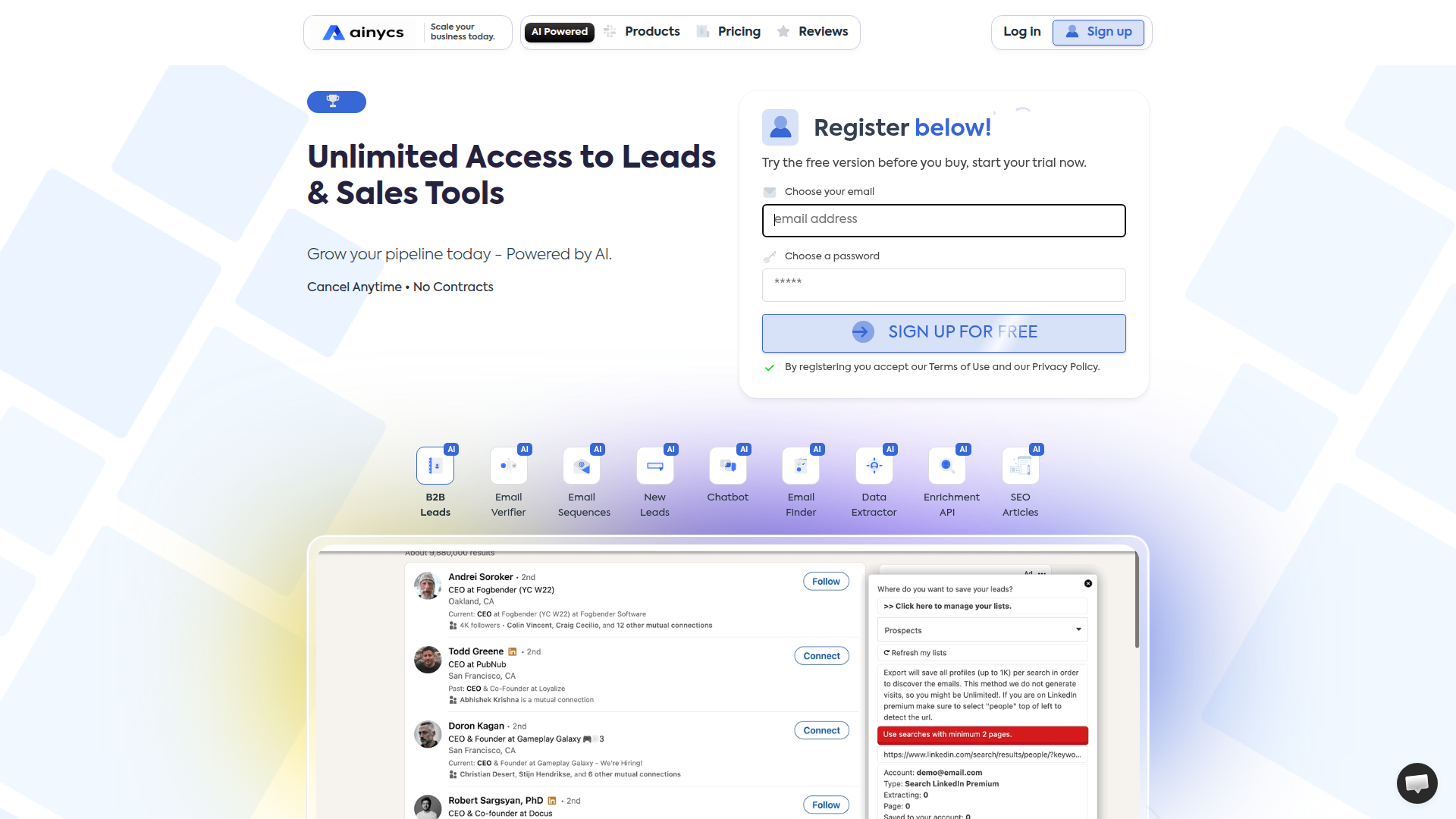
Unlock the full potential of your lead generation strategy with Ainycs, an AI-powered software suite that transforms the way businesses acquire and nurture leads. With tools like the B2B leads extractor from LinkedIn and customizable email sequences, Ainycs ensures that your outreach campaigns are both efficient and effective. By simplifying complex processes and offering unlimited access plans, Ainycs is the perfect partner for any organization aiming to boost sales through advanced AI technology. Discover more about Ainycs today!
FAQ
- What should be the first step before automating lead generation with AI?
Before automating lead generation with AI, it's essential to clearly define your lead generation objectives. Determine whether you need high-volume, low-quality leads or fewer, higher-quality prospects. This clarity will guide your strategy and help in selecting the right AI tools. - How do I choose the right AI tools for lead generation?
To choose the right AI tools, understand their key features and benefits, such as automating repetitive tasks and analyzing large datasets. Evaluate tools based on criteria like ease of use, integration capabilities, and support services to ensure they align with your business needs. - What are the key setup requirements for optimizing AI tools?
Optimizing AI tools requires ensuring that your data is clean and well-organized. Verify that customer databases are up-to-date and free from duplicates. Also, ensure the AI tools can seamlessly integrate with your existing CRM or marketing platforms for a smoother transition. - How can AI tools be integrated with an existing CRM system?
To integrate AI tools with a CRM system, assess the technical specifications of both to ensure compatibility. Consider factors like data formats and API availability. Ensure that the integration can scale with your business growth, avoiding significant reconfiguration in the future. - What considerations should be made before launching AI-driven lead generation campaigns?
Before launching AI-driven campaigns, identify your target audience with precision, defining demographic details such as age and location. Set clear objectives like increasing brand awareness or generating qualified leads, and ensure your data is clean and well-organized for accurate AI predictions. - How can AI be utilized for data enrichment and lead scoring?
AI-driven data enrichment involves enhancing existing data by filling gaps with additional information, such as social media profiles. This enriched data forms the foundation for effective lead scoring, allowing businesses to prioritize leads more efficiently and tailor marketing efforts. - What are the benefits of using AI-powered email campaigns for outreach?
AI-powered email campaigns leverage machine learning algorithms to personalize and automate outreach. By analyzing past interactions and customer behavior, AI tools craft tailored messages, increasing engagement likelihood. Features like segmentation and predictive analytics enhance targeting and effectiveness. - What features should an effective lead generation chatbot have?
An effective lead generation chatbot should engage visitors in real time, providing instant responses to queries. It should qualify prospects using frameworks like BANT or CHAMP and collect essential data for further engagement, maximizing its potential in lead generation. - How can you monitor and analyze AI-driven lead generation results?
Monitor specific metrics such as conversion rates and lead quality to evaluate AI-driven lead generation success. Tracking the cost per lead helps determine financial efficiency. Regularly review these metrics to ensure that AI tools are meeting expectations and contributing effectively. - What common issues might arise in AI lead generation, and how can they be addressed?
Common issues in AI lead generation include poor data quality, leading to inaccurate predictions. Ensure data is clean, accurate, and up-to-date. Integration challenges can also arise; ensure compatibility between AI tools and existing systems to prevent performance hindrances.