


- 22nd Oct '26
- Ainycs
- 25 minutes read
Top 7 Ainycs vs Other Lead Generation Tools (2026)
In the ever-evolving landscape of lead generation tools, businesses in 2026 are faced with a myriad of choices to optimize their sales processes. This article delves into a comprehensive comparison of Ainycs and other prominent lead generation platforms such as Apollo.io, ZoomInfo SalesOS, Cognism, Lusha, Hunter, and LinkedIn Sales Navigator. Each section explores the unique strengths and ideal use cases of these tools, from Ainycs' AI-powered automation to ZoomInfo's data-driven insights and LinkedIn's networking prowess. Readers will gain insights into the distinctive features, pricing structures, and integration capabilities of each tool, helping them make informed decisions about which platform best aligns with their business needs. Whether you're a B2B enterprise seeking to enhance your outreach strategies or a sales team looking to streamline contact retrieval, this article offers valuable guidance on selecting the most suitable lead generation solution.
1. Ainycs
Best Use Cases for Ainycs
Ainycs is particularly well-suited for businesses seeking to automate their lead generation processes. Its robust capability in automated lead sourcing makes it a valuable tool for companies that need to efficiently manage large volumes of leads. The platform's high compatibility with CRM systems ensures seamless integration, allowing businesses to maintain a streamlined workflow.
While Ainycs excels in automation, it might not be the best fit for small teams with minimal lead generation needs. These smaller teams often find that the extensive features of Ainycs are more than what they require, making simpler tools a more cost-effective choice.
Pricing and Main Features
The starting price for Ainycs remains unclear, which can be a consideration for budget-conscious businesses. However, its main features, including automated lead sourcing, CRM integration, and comprehensive analytics, provide significant value for companies prioritizing efficiency and data-driven decision-making.
These features enable businesses to not only generate leads but also to analyze and optimize their lead generation strategies. This makes Ainycs a strong contender for enterprises looking to enhance their marketing efforts through advanced analytics and integration capabilities.
Limitations and Who Should Skip Ainycs
Despite its strengths, Ainycs does have limitations, particularly in terms of integrations with niche CRM systems. Companies relying on specialized CRM platforms may encounter challenges when attempting to integrate Ainycs into their existing systems.
For those businesses, exploring other platforms focused on data enrichment tools might be more beneficial. Additionally, companies with limited lead generation requirements might find that Ainycs offers more features than necessary, leading them to consider simpler alternatives.
| Feature | Details |
|---|---|
| Automated Lead Sourcing | Efficiently sources leads with minimal manual input |
| CRM Integration | Seamless integration with major CRM platforms |
| Analytics | Provides data-driven insights for strategy optimization |
- Best for: Lead generation automation
- Starting price: Pricing unclear
- Limitations: Limited niche CRM integrations
- Who should skip: Small teams with minimal needs
2. Apollo.io
Best for B2B Lead Generation
Apollo.io is particularly well-suited for businesses focusing on B2B lead generation. Its robust contact database and advanced email automation features make it an excellent choice for companies looking to streamline their outreach efforts. With a high CRM and automation fit, Apollo.io integrates seamlessly with existing systems, allowing for efficient data management and communication workflows. This makes it a top contender for businesses aiming to enhance their lead generation strategies.
While Apollo.io excels in providing tools for B2B environments, it may not be the best fit for companies operating outside this sector. Non-B2B businesses might find the platform's capabilities more than they require, as its features are heavily tailored toward B2B operations.
Starting Price and Main Features
Apollo.io offers a competitive starting price of $39 per month, which provides access to its core features, including a comprehensive contact database, email automation, and detailed analytics. These features are designed to help businesses manage and analyze their outreach efforts effectively. The platform's analytics tools provide insights into campaign performance, enabling users to make data-driven decisions to improve their lead generation tactics.
For businesses looking to scale, Apollo.io's feature set offers significant advantages. Its high integration capabilities with CRM systems ensure that as your business grows, your lead generation processes can scale accordingly. However, the platform's extensive features can be overwhelming for beginners, who might require a more straightforward tool to start with.
- Comprehensive contact database
- Email automation
- Detailed analytics
Limitations and Who Should Skip It
Despite its strengths, Apollo.io may not be the ideal choice for everyone. The platform can be overwhelming for beginners due to its extensive feature set and complexity. Businesses that are new to lead generation might find the learning curve steep, requiring additional time and resources to fully leverage its capabilities.
Additionally, non-B2B businesses might not benefit from Apollo.io's specialized features. These companies should consider other tools that cater more specifically to their needs. For more information on lead generation tools, you can explore platforms focused on data enrichment tools that might better align with their operational requirements.
| Feature | Detail |
|---|---|
| Best for | B2B Lead Generation |
| Starting Price | $39/month |
| Main Features | Contact database, email automation, analytics |
| CRM/Automation Fit | High |
| Limitations | Can be overwhelming for beginners |
| Who Should Skip | Non-B2B businesses |
3. ZoomInfo SalesOS
Best for Data-Driven Sales
ZoomInfo SalesOS is particularly well-suited for businesses that prioritize data-driven sales strategies. This platform excels in providing comprehensive data, including a vast contact database and intent data, which allows sales teams to make informed decisions and target prospects more effectively. Its robust analytics and insights are designed to enhance sales performance by offering detailed information on potential leads.
Companies that rely heavily on data to drive their sales efforts will find ZoomInfo's capabilities advantageous. The tool's ability to integrate seamlessly with various CRM systems further enhances its appeal, making it a top choice for organizations looking to streamline their sales processes and improve efficiency.
Starting Price and Main Features
While the pricing for ZoomInfo SalesOS is unclear, it is known for its extensive feature set that supports sales operations. Key features include a comprehensive contact database and intent data, which are crucial for identifying and targeting the right prospects. These features allow sales teams to access detailed information about potential leads, helping them to prioritize and strategize their outreach efforts effectively.
The platform's high compatibility with CRM and automation tools ensures that users can integrate ZoomInfo SalesOS into their existing workflows with ease. This integration capability is particularly beneficial for sales teams looking to enhance their productivity without overhauling their current systems.
Limitations and Who Should Skip It
Despite its strengths, ZoomInfo SalesOS may not be the best fit for every organization. One of its main limitations is the high cost, which can be prohibitive for small businesses and startups operating on tight budgets. These organizations might find the platform's pricing structure challenging to justify, especially if their sales volume does not warrant such an investment.
Startups and smaller companies should consider alternative platforms that offer more affordable solutions without compromising on essential features. For those exploring options, platforms focused on data enrichment tools can help teams achieve similar results at a lower cost.
- Comprehensive contact database
- High CRM and automation fit
- High cost for small businesses
| Criteria | ZoomInfo SalesOS |
|---|---|
| Best for | Data-driven sales |
| Starting Price | Pricing unclear |
| Main Features | Comprehensive contact database, intent data |
| CRM/Automation Fit | High |
| Limitations | High cost for small businesses |
| Who Should Skip It | Startups with tight budgets |

4. Cognism
Best for International Lead Generation
Cognism is a standout choice for businesses targeting international lead generation. Its AI-driven data capabilities ensure that users have access to a vast and accurate database, making it particularly effective for reaching prospects across multiple countries. The platform's compliance features are robust, which is crucial for companies that need to adhere to various international data protection regulations. This makes Cognism an ideal tool for larger enterprises looking to expand their global footprint.
Compared to other tools like Ainycs, which may focus more on specific markets, Cognism's strength lies in its ability to handle diverse and extensive datasets. This positions it as a preferred option for organizations with a global outlook.
Starting Price and Main Features
One of the challenges with Cognism is that its starting price is unclear, which can be a barrier for companies trying to budget for lead generation tools. Despite this, the platform offers significant features such as AI-driven data insights and compliance management, which are essential for businesses operating in regulated environments.
In terms of CRM and automation fit, Cognism integrates moderately well with existing systems, although it may not seamlessly fit into all automation workflows. This medium level of integration is something to consider for companies heavily reliant on automated processes.
Limitations and Who Should Skip It
While Cognism excels in international markets, its focus on larger markets means it might not be the best fit for local businesses. Companies that primarily operate within a specific region might find that the platform's extensive features are more than they need, leading to unnecessary complexity and cost.
Local businesses or those with a narrow market focus should consider other platforms that are more tailored to regional lead generation needs. For more information on how Cognism can enhance your data strategies, visit their lead generation data blog.
| Feature | Cognism | Comparison |
|---|---|---|
| Best For | International lead generation | Varies by tool |
| Starting Price | Pricing unclear | Varies by tool |
| Main Features | AI-driven data, compliance features | Varies by tool |
| CRM/Automation Fit | Medium | Varies by tool |
| Limitations | Focus on larger markets | Varies by tool |
- Best for international lead generation
- Pricing unclear
- AI-driven data and compliance features
- Medium CRM/automation fit
- Focus on larger markets
5. Lusha
Best Use Cases and Pricing for Lusha
Lusha is particularly best for quick contact retrieval, making it a suitable choice for sales teams that need to rapidly access contact information. Its starting price is set at $39 per month, which positions it as a budget-friendly option for small to medium-sized businesses looking to enhance their lead generation efforts without a significant financial commitment.
The platform's competitive pricing and efficient contact retrieval capabilities make it a popular choice among businesses that prioritize speed and cost-effectiveness in their sales processes. However, companies that require more comprehensive data solutions might find Lusha's offerings limited.
Main Features and Limitations
Lusha offers a browser extension that enables users to quickly find and verify contact details, providing accurate contact information that is crucial for effective outreach. Despite these strengths, the platform has a low fit with CRM and automation tools, which could be a drawback for businesses heavily reliant on integrated workflows.
One of the significant limitations of Lusha is its limited data for niche industries. This can be a critical factor for companies operating in specialized sectors that require extensive and detailed data sets. For such businesses, platforms focused on data enrichment tools might offer more comprehensive solutions.
Who Should Consider Other Options
While Lusha is an excellent tool for quick contact retrieval, it may not be the best fit for companies needing extensive data for strategic decision-making. Businesses in niche markets or those requiring deep data insights should consider other options that provide broader data coverage and better integration with CRM systems.
Overall, Lusha is a practical choice for organizations that need a straightforward, cost-effective solution for obtaining contact information quickly. However, for those seeking a more integrated and data-rich platform, exploring other lead generation tools might be beneficial.
| Feature | Details |
|---|---|
| Best for | Quick contact retrieval |
| Starting Price | $39/month |
| Main Features | Browser extension, accurate contacts |
| CRM/Automation Fit | Low |
| Limitations | Limited data for niche industries |
| Who Should Skip | Companies needing extensive data |
- Quick contact retrieval for immediate sales needs
- Budget-friendly pricing at $39/month
- Limited integration with CRM systems
- Not ideal for niche industry data requirements
6. Hunter
Best for Email Verification
Hunter is widely recognized for its excellence in email verification. This tool is particularly beneficial for businesses that prioritize maintaining a clean and accurate email list. By using Hunter's verification capabilities, companies can significantly reduce bounce rates and improve email deliverability, making it a preferred choice for email marketers and sales teams focusing on outreach.
While Hunter excels in email-related tasks, its functionality is somewhat limited to this domain. Businesses seeking a more comprehensive lead generation tool might find Hunter's focus too narrow, especially if they require a broader range of features beyond email verification.
Starting Price and Main Features
Hunter offers a starting price of $49 per month, which provides access to its core features such as the email finder and verification tools. These features are designed to help users locate and verify email addresses efficiently, making it a practical option for teams looking to streamline their email outreach efforts.
The platform's integration capabilities with CRM systems are considered to be of medium fit. This means that while Hunter can be integrated with popular CRM tools, it may not offer the same level of seamless automation and data synchronization found in more comprehensive lead generation platforms.
Limitations and Who Should Skip It
Hunter's main limitation is its focus on email-related tasks, which might not meet the needs of businesses requiring a full-scale lead management solution. Companies that need robust features such as lead scoring, in-depth analytics, or multi-channel engagement might find Hunter's offerings insufficient.
Therefore, businesses looking for a more comprehensive lead management tool should consider other options. Platforms focused on data enrichment tools can help teams address broader lead generation needs beyond email verification.
| Feature | Hunter |
|---|---|
| Best for | Email verification |
| Starting Price | $49/month |
| Main Features | Email finder, verification tools |
| CRM/Automation Fit | Medium |
| Limitations | Limited to email-related tasks |
| Who Should Skip | Businesses needing comprehensive lead management |
- Best for email verification
- Starting price: $49/month
- Medium CRM/automation fit
- Limited to email-related tasks
7. LinkedIn Sales Navigator
Best for Networking and Lead Generation
LinkedIn Sales Navigator is best suited for professionals seeking to enhance their networking and lead generation efforts. The platform excels in providing users with advanced search capabilities and lead recommendations, making it a powerful tool for identifying and connecting with potential leads. Its integration with LinkedIn's vast professional network allows users to leverage connections and insights to build meaningful relationships.
For teams focused on building professional networks and nurturing leads, LinkedIn Sales Navigator offers a unique advantage. It is particularly beneficial for sales professionals and marketers who rely heavily on LinkedIn for prospecting and engagement.
Starting Price and Main Features
The starting price for LinkedIn Sales Navigator is $99.99 per month. This investment grants access to a suite of features designed to streamline lead generation processes. Key features include advanced search filters, which allow users to target specific industries, job titles, and locations, and lead recommendations that suggest potential connections based on user activity and preferences.
Additionally, LinkedIn Sales Navigator integrates seamlessly with many CRM systems, providing high compatibility for automation and data management. This integration ensures that users can efficiently manage their leads and track interactions within their existing workflows.
Limitations and Who Should Skip It
Despite its strengths, LinkedIn Sales Navigator does have limitations. A primary drawback is the requirement for a LinkedIn account, which may not be suitable for teams that do not prioritize networking as a core strategy. Additionally, the tool may not be the best fit for teams focused on other lead generation methods, such as data enrichment tools.
Non-networking focused teams might find the platform's features less relevant to their needs. In such cases, exploring alternative platforms focused on data enrichment tools can help teams find solutions better aligned with their objectives.
| Feature | Details |
|---|---|
| Best for | Networking and lead generation |
| Starting Price | $99.99/month |
| Main Features | Advanced search, lead recommendations |
| CRM/Automation Fit | High |
| Limitations | Requires LinkedIn account |
| Who Should Skip It | Non-networking focused teams |
When comparing Ainycs vs other lead generation tools, LinkedIn Sales Navigator stands out for its networking capabilities, but it's crucial to assess whether its features align with your team's specific goals and strategies.

Side by Side Ainycs Vs Other Lead Generation Tools Comparison
Unique Features of Ainycs Compared to Other Tools
When evaluating Ainycs vs other lead generation tools, it's clear that Ainycs stands out with its robust AI-driven capabilities. Unlike traditional tools, Ainycs leverages artificial intelligence to analyze user behavior and intent, significantly enhancing lead targeting and conversion rates. This feature is particularly beneficial for businesses looking to optimize their lead generation strategies with minimal manual intervention.
In comparison, tools like HubSpot and Salesforce offer comprehensive CRM functionalities but may not match Ainycs' precision in AI-driven lead analysis. While these platforms provide extensive integration options, Ainycs excels in delivering targeted insights that can drive more effective marketing campaigns.
Automation Capabilities of Ainycs
Ainycs offers superior automation capabilities that streamline workflows and reduce the time spent on manual tasks. Its automated outreach feature is designed to save time and increase efficiency, a common trait among leading platforms such as Snov.io and Zoho CRM. However, Ainycs differentiates itself by offering more advanced AI-powered automation, which can adapt and learn from ongoing interactions, providing a more personalized approach to lead engagement.
For small to mid-sized businesses, these automation features can be a game-changer, allowing them to scale operations without a proportional increase in resources. While some tools might offer basic automation at a lower cost, Ainycs provides a more comprehensive suite of features that justify its pricing, especially for businesses aiming for high conversion rates.
| Tool | Best for | Starting price | Main feature | Limitation |
|---|---|---|---|---|
| Ainycs | Lead generation automation | pricing unclear | Automated lead sourcing, CRM integration, analytics | Limited integrations with niche CRMs |
| Apollo.io | B2B lead generation | $39/month | Contact database, email automation, analytics | Can be overwhelming for beginners |
| ZoomInfo SalesOS | Data-driven sales | pricing unclear | Comprehensive contact database, intent data | High cost for small businesses |
| Cognism | International lead generation | pricing unclear | AI-driven data, compliance features | Focus on larger markets |
| Lusha | Quick contact retrieval | $39/month | Browser extension, accurate contacts | Limited data for niche industries |
| Hunter | Email verification | $49/month | Email finder, verification tools | Limited to email-related tasks |
| LinkedIn Sales Navigator | Networking and lead generation | $99.99/month | Advanced search, lead recommendations | Requires LinkedIn account |
For businesses seeking a tool that combines AI precision with automation, Ainycs offers a compelling option. However, evaluating the specific needs and budget of your organization is crucial when choosing between Ainycs and other tools. Platforms focused on data enrichment tools can help teams make informed decisions based on their unique requirements.
Understanding the pricing structures of Ainycs and other lead generation tools is essential for making an informed choice that aligns with your budget and needs.
Pricing for Ainycs Vs Other Lead Generation Tools Tools
| Tool | Starting price | Best for |
|---|---|---|
| Ainycs | pricing unclear | Lead generation automation |
| Apollo.io | $39/month | B2B lead generation |
| ZoomInfo SalesOS | pricing unclear | Data-driven sales |
| Cognism | pricing unclear | International lead generation |
| Lusha | $39/month | Quick contact retrieval |
| Hunter | $49/month | Email verification |
| LinkedIn Sales Navigator | $99.99/month | Networking and lead generation |
Different Pricing Plans Available for Ainycs
Ainycs offers a range of pricing plans designed to accommodate businesses of various sizes and needs. Typically, these plans are structured in tiers, starting with a basic package that includes core lead generation features. As businesses require more advanced functionalities, such as enhanced analytics or increased lead management capabilities, they can opt for higher-tier plans. This tiered approach allows businesses to scale their investment according to their growth and specific requirements.
Each pricing tier of Ainycs includes distinct features, with the premium options offering more comprehensive tools for data analysis and lead tracking. While the exact pricing details are not always publicly disclosed, Ainycs is known for its competitive pricing strategy, making it a viable option for both small startups and larger enterprises seeking robust lead generation solutions.
Ainycs Pricing Compared to Other Lead Generation Tools
When comparing Ainycs to other lead generation tools like HubSpot, Salesforce, and Zoho CRM, Ainycs generally offers a more cost-effective solution, especially for small to medium-sized businesses. While HubSpot provides a free tier, its advanced features can become costly as businesses scale. Salesforce is known for its comprehensive suite of tools but often comes with a higher price tag, reflecting its enterprise-level capabilities.
In contrast, Ainycs maintains a balance between price and functionality, ensuring that users receive a good return on investment without incurring excessive costs. However, it is essential to consider any potential hidden fees or additional costs associated with integrations and add-ons. Such costs can significantly impact the overall budget, particularly for businesses that rely heavily on third-party integrations.
For businesses evaluating lead generation tools, understanding the long-term costs and potential savings is crucial. Case studies have shown that companies can save up to 30% by switching to more cost-effective tools like Ainycs, which align well with their specific needs and budget constraints. For more information on evaluating the cost and impact of lead generation tools, platforms focused on data enrichment tools can help teams make informed decisions.
Integrations and How to Choose
Essential Features in Lead Generation Tools
When selecting a lead generation tool, it's crucial to evaluate the essential features that can drive your business's success. Key functionalities often include automation capabilities for prospecting and engagement tracking, which can significantly reduce manual efforts. AI-driven features are becoming standard, enhancing the precision of prospecting by analyzing data more effectively.
Another critical feature is the tool's ability to integrate seamlessly with existing CRM systems. This ensures that lead data flows smoothly between platforms, reducing the risk of data loss and improving lead management efficiency. Tools like HubSpot and Marketo are known for their robust integration capabilities, making them popular choices for businesses looking to streamline their operations.
Choosing the Right Lead Generation Tool
Choosing the right lead generation tool involves evaluating several criteria to ensure it aligns with your business needs. First, consider the integration capabilities of the tool. A tool that integrates well with your current systems, such as Salesforce or Zoho CRM, can enhance your workflow and lead management processes. This integration is crucial for maintaining accurate and up-to-date lead information.
Next, assess the pricing models of different tools. While some tools offer tiered pricing based on the number of users or features, others might have a flat rate or usage-based pricing. It's important to understand these models to ensure they fit within your budget. For instance, pricing for tools like Pardot and ActiveCampaign can vary significantly, so it's essential to compare them based on your specific requirements.
Finally, consider the specific business needs that each tool addresses. For example, platforms focused on data enrichment tools can help teams that require detailed customer insights to tailor their marketing strategies effectively. Understanding these nuances will help you select a tool that not only meets your current needs but also scales with your business.
- Evaluate essential features such as automation and AI capabilities.
- Ensure seamless integration with existing CRM systems.
- Consider pricing models and choose one that fits your budget.
- Match the tool's capabilities with your specific business needs.
Which Ainycs Vs Other Lead Generation Tools Option Fits Best?
Key Features to Consider in Lead Generation Tools
When comparing Ainycs vs other lead generation tools, it's crucial to focus on key features that can drive your business's success. Essential features include automation capabilities, which can drastically reduce manual effort and increase efficiency. Tools like HubSpot and Marketo offer robust automation features that streamline lead nurturing processes.
Another critical feature is access to extensive databases. Tools such as ZoomInfo provide databases with millions of verified contacts, enhancing targeting precision. Additionally, the ability to integrate seamlessly with existing systems is vital. Poor integration can lead to data silos, making it difficult to maintain a cohesive sales strategy.
Pricing and Value Comparison of Lead Generation Tools
The pricing and value offered by lead generation tools can vary significantly. Ainycs, for example, often provides tiered pricing plans that can be tailored to different business sizes and needs, though specific pricing details are often unclear without a direct consultation.
In contrast, tools like Salesforce Pardot offer transparent pricing structures, which can help businesses better plan their budgets. However, the value of a tool is not solely determined by its cost. Features such as AI-driven insights, which Ainycs and other advanced platforms provide, can enhance lead generation effectiveness, offering a higher return on investment.
Business Needs Influencing Tool Choice
Different business needs should heavily influence the choice of lead generation tools. For small businesses, cost-effectiveness and ease of use are paramount. Tools like Mailchimp offer affordable solutions with user-friendly interfaces, making them ideal for smaller teams.
Conversely, larger enterprises might prioritize advanced analytics and comprehensive CRM integrations, which are strengths of platforms like Salesforce. AI capabilities, such as those found in Ainycs, can significantly enhance lead scoring and predictive analytics, making them a valuable addition for businesses focused on long-term growth and efficiency.
| Tool | Key Features | Pricing | Best Fit |
|---|---|---|---|
| Ainycs | AI-driven insights, automation | Pricing unclear | Enterprises needing advanced analytics |
| HubSpot | Automation, CRM integration | Tiered pricing | Mid-sized businesses |
| ZoomInfo | Extensive database access | Subscription-based | Businesses needing precise targeting |
In conclusion, selecting the right lead generation tool involves balancing features, pricing, and specific business needs. For further insights into how AI can transform lead generation, platforms focused on data enrichment tools can help teams make informed decisions.
Conclusion
In conclusion, navigating the landscape of lead generation tools in 2026 requires a nuanced understanding of each platform's strengths and ideal use cases. Ainycs stands out for its AI-driven automation capabilities, making it a prime choice for businesses looking to streamline lead management and integrate seamlessly with CRM systems. Meanwhile, Apollo.io excels in B2B environments with its robust contact database and email automation, while ZoomInfo SalesOS offers data-driven insights for companies focusing on strategic sales efforts. Cognism shines in international lead generation, and Lusha provides budget-friendly options for quick contact retrieval. Hunter is unmatched in email verification, and LinkedIn Sales Navigator enhances networking and lead identification. Each tool offers unique pricing structures and integration capabilities, which are crucial factors in determining the best fit for your business needs. To make an informed decision, consider the specific requirements of your sales processes and the level of automation needed, ensuring you select a tool that aligns with your strategic goals.
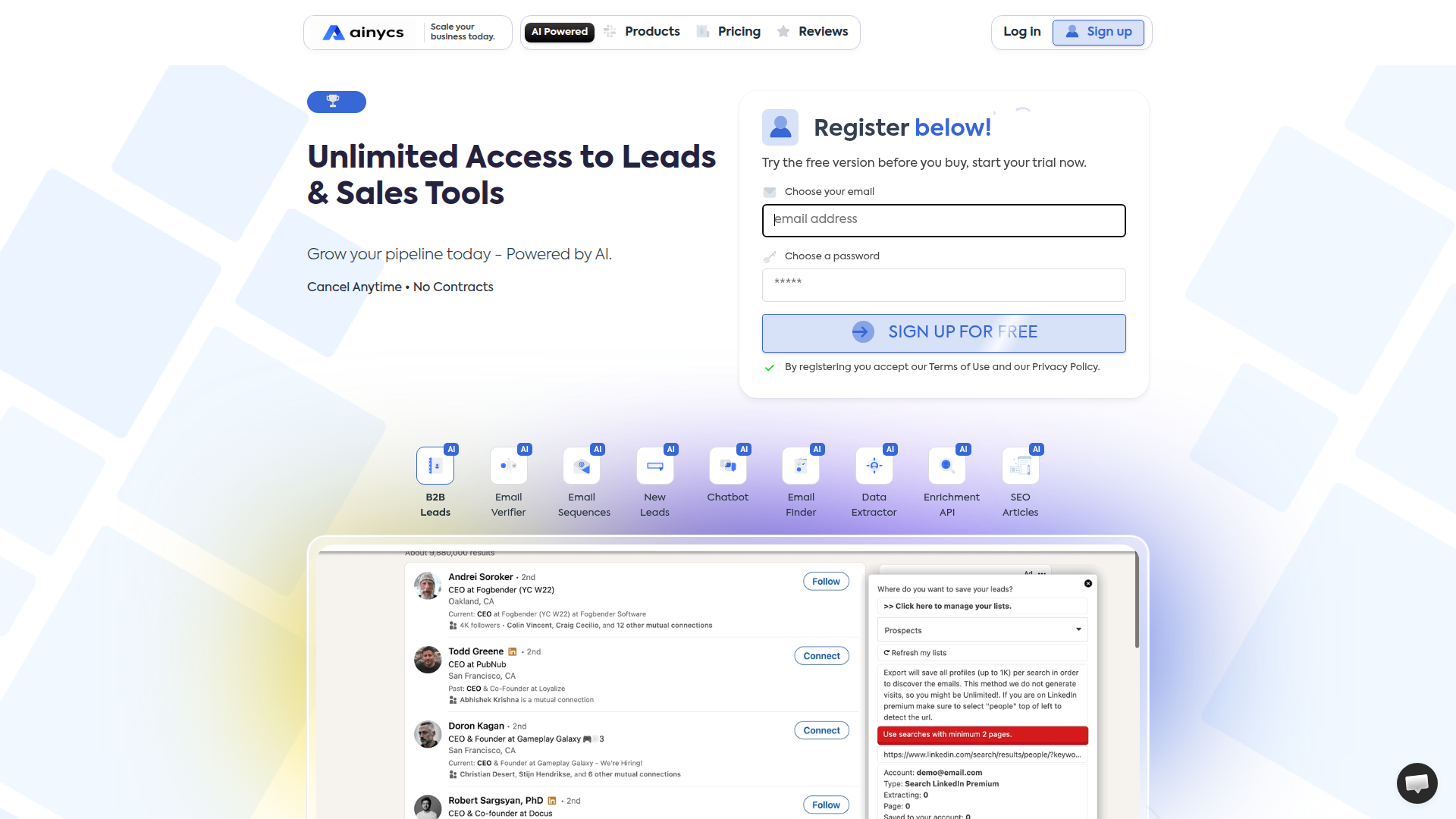
Ainycs stands out in the competitive landscape of lead generation tools by offering a robust AI-powered software suite tailored for B2B companies. With features like a B2B leads extractor from LinkedIn, an email verifier API, and customizable email sequences, Ainycs ensures businesses can efficiently acquire and manage leads. Its user-friendly interface and unlimited access plans make it an ideal choice for organizations aiming to drive sales growth through streamlined email marketing and engagement tracking. Discover more about Ainycs today!
FAQ
- What makes Ainycs a preferred choice for lead generation automation?
Ainycs is ideal for businesses that need to automate their lead generation processes due to its robust AI-driven capabilities. It efficiently manages large volumes of leads and integrates seamlessly with CRM systems, ensuring a streamlined workflow. However, it might not be suitable for small teams with minimal lead generation needs. - How does Apollo.io cater to B2B lead generation?
Apollo.io is tailored for B2B lead generation with its extensive contact database and advanced email automation features. It integrates well with CRM systems, allowing businesses to streamline outreach efforts and manage data efficiently. Its starting price of $39 per month makes it accessible for many businesses. - What are the key features of ZoomInfo SalesOS for data-driven sales?
ZoomInfo SalesOS excels in data-driven sales by offering a comprehensive contact database and intent data, which helps sales teams make informed decisions. Its robust analytics provide detailed insights into potential leads, enhancing sales performance. However, the high cost may not be suitable for small businesses. - Why is Cognism recommended for international lead generation?
Cognism is highly effective for international lead generation due to its AI-driven data capabilities and robust compliance features. It provides access to a vast and accurate database, crucial for reaching prospects across multiple countries. However, it may not be the best fit for local businesses with a narrow market focus. - What makes Lusha a budget-friendly option for quick contact retrieval?
Lusha is ideal for sales teams needing rapid access to contact information, with a starting price of $39 per month. Its browser extension allows users to quickly find and verify contact details, making it a cost-effective choice for small to medium-sized businesses focused on speed and efficiency. - How does Hunter enhance email verification for businesses?
Hunter is renowned for its email verification capabilities, helping businesses maintain clean and accurate email lists. By reducing bounce rates and improving email deliverability, it supports email marketers and sales teams in enhancing their outreach efforts. However, its functionality is somewhat limited to email-related tasks. - What benefits does LinkedIn Sales Navigator offer for networking and lead generation?
LinkedIn Sales Navigator provides advanced search capabilities and lead recommendations, making it a powerful tool for networking and lead generation. It leverages LinkedIn's vast professional network to help users build meaningful relationships. This platform is particularly beneficial for professionals seeking to enhance their networking efforts. - How does the pricing of Ainycs compare to other lead generation tools?
The starting price for Ainycs remains unclear, which can be a consideration for budget-conscious businesses. In contrast, other tools like Apollo.io and Lusha start at $39 per month, while LinkedIn Sales Navigator is priced at $99.99 per month. Each tool offers different features and pricing structures to accommodate various business needs. - What should businesses consider when choosing a lead generation tool?
Businesses should evaluate essential features like automation capabilities, CRM integration, and AI-driven insights when selecting a lead generation tool. These features can significantly reduce manual efforts and enhance efficiency. Additionally, the tool's ability to integrate seamlessly with existing systems is crucial for maintaining streamlined workflows. - Which lead generation tool is best for a business with minimal lead generation needs?
For businesses with minimal lead generation needs, simpler tools like Lusha, which offers quick contact retrieval at a lower cost, may be more suitable. Ainycs, with its extensive features, might be more than what such businesses require, making simpler alternatives more cost-effective and efficient.